Energy Star vs Regular Dehumidifier: Complete Technical Guide
Choosing the right moisture extraction unit impacts your long-term utility bills and basement humidity control. Understanding internal engineering differences ensures optimal structural mold prevention.

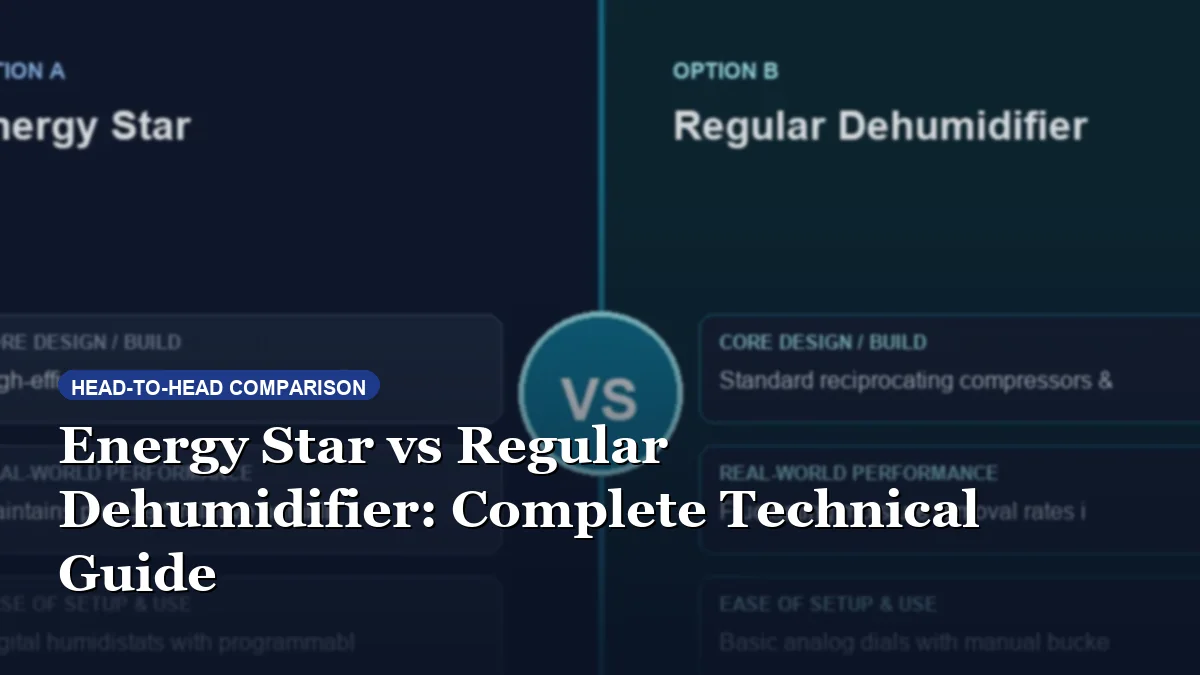
Choose an Energy Star certified model for maximum electrical efficiency and continuous damp basements. Select a standard dehumidifier only for temporary job-site drying where upfront equipment availability matters most.
Compare all top models in our Best Dehumidifier: Top Picks for Healthy Indoor Air.
Side-by-Side Breakdown
| Criteria | Energy Star | Regular Dehumidifier | Edge |
|---|---|---|---|
| Core Design / Build | High-efficiency rotary compressors & optimized coils | Standard reciprocating compressors & older coil geometry | Energy Star |
| Real-World Performance | Maintains precise relative humidity under 50 percent | Fluctuating moisture removal rates in cold basements | Energy Star |
| Ease of Setup & Use | Digital humidistats with programmable drain timers | Basic analog dials with manual bucket emptying | Energy Star |
| Durability & Reliability | Engineered for continuous multi-season operation | Prone to thermal overload during heavy summer loads | Energy Star |
| Efficiency / Operating Footprint | Consumes up to 15 percent less energy overall | Higher wattage draw per pint of water removed | Energy Star |
| Maintenance Requirements | Accessible washable mesh filters with auto-shutoff | Standard filters needing frequent manual checks | Energy Star |
| Best Ideal Use Case | Long-term residential crawlspaces and damp basements | Short-term renovation drying and unconditioned garages | Energy Star |
Core Engineering and Compressor Design Differences
Energy Star certified units utilize advanced rotary compressors designed to cycle refrigerant efficiently. This internal engineering minimizes friction losses during continuous operation cycles.

Regular dehumidifiers frequently rely on legacy reciprocating compressors. These older mechanical designs consume more electrical current to achieve identical moisture extraction rates.
Coil surface area also differs significantly between these two thermal categories. Certified models feature denser aluminum fin configurations to maximize heat exchange efficiency.
Selecting from our best energy star dehumidifier picks ensures you get advanced variable-speed compressors and larger copper coils that optimize thermodynamic efficiency and reduce mechanical wear.
Standard non-certified models typically rely on traditional fixed-speed reciprocating compressors that cycle on and off abruptly, drawing higher surge currents and generating excess thermal stress within the sealed refrigerant circuit.
Internal electronic control boards in efficient variants modulate fan motor speeds more precisely, utilizing brushless DC motors that consume less wattage while maintaining consistent airflow across dense evaporator fins.
- Rotary compressors reduce mechanical friction and operating noise levels.
- Reciprocating compressors draw higher initial startup amperage surges.
- Optimized evaporator coils extract moisture faster at lower ambient temperatures.
Refrigerant Circuitry and Heat Exchange
The refrigeration cycle inside an efficient dehumidifier uses modern eco-friendly compounds. These fluids transfer thermal energy rapidly across copper tubing networks.
Standard units often use older refrigerant blends with lower volumetric cooling capacities. Consequently, they must run longer compressor cycles to achieve similar dryness levels.
- Modern R32 or R410A refrigerants improve overall system thermal conductivity.
- Enlarged condenser tubing prevents premature icing during cold basement operations.
Real-World Moisture Removal Performance
Extracting moisture from humid indoor environments requires precise thermal management. Certified units maintain consistent extraction volumes even when ambient basement temperatures drop significantly.
Non-certified appliances often struggle with frost accumulation on cold evaporator coils. This operational flaw forces frequent defrost cycles that halt actual water extraction entirely.
User testing confirms that energy-efficient units maintain tighter humidity tolerances. Your living space stays safely below critical mold growth thresholds without constant manual adjustments.
Actual extraction rates depend heavily on ambient relative humidity and temperature, with certified units maintaining rated pint capacities even under demanding, cooler basement conditions where standard units struggle noticeably.
Regular appliances often experience rapid evaporator icing in spaces below sixty-five degrees Fahrenheit, triggering frequent defrost cycles that interrupt continuous moisture extraction and lower overall daily water removal totals.
Advanced sensor arrays in efficient models dynamically adjust fan speeds to optimize latent heat transfer, ensuring consistent relative humidity reduction without over-drying or wasting electrical power during partial-load conditions.
- Consistent pint extraction rates across varying ambient temperature ranges.
- Reduced risk of evaporator coil freeze-ups in unheated crawlspaces.
- Precise onboard humidistats prevent over-drying and excessive power waste.
Low-Temperature Operation Mechanics
Operating in cool spaces below sixty degrees Fahrenheit tests internal defrost sensors, which is why exploring our best energy star dehumidifier for basement selections highlights automated gas-bypass systems.
Standard units lack sophisticated low-temperature controls, leading to solid ice blocks. Once iced over, the machine stops pulling water from your indoor air.
- Automatic defrost sensors protect internal components from ice damage.
- Continuous drainage remains active even during chilly spring basement runs.
Electrical Efficiency and Power Consumption
Electrical efficiency represents the primary divergence in long-term operating costs. Certified appliances utilize low-wattage fan motors and high-efficiency electrical transformers.
Running a standard unit continuously throughout the humid summer months adds noticeable expense. The inefficient compressor draws excessive amperage hour after operating hour.
Evaluating wattage ratings per pint of extracted water reveals clear operational savings, as highlighted inside our detailed tosot 50 pint dehumidifier review showing how you extract more moisture while drawing fewer kilowatts.
Certified dehumidifiers dramatically reduce wattage consumption by up to fifteen percent compared to older baseline designs, translating directly into noticeable savings on monthly residential utility bills over time.
Standard compressors demand higher starting amperage, which strains household electrical circuits and generates unnecessary resistive heat losses along internal wiring harnesses during prolonged continuous operational cycles.
Integrating intelligent power management modules allows modern efficient systems to idle at minimal wattage draws once target relative humidity thresholds are successfully achieved within the treated indoor environment.
- Lower annual kilowatt-hour usage lowers monthly utility expenditures.
- Energy Star standards mandate strict standby power limits when plugged in.
- High-efficiency fan blades move air quietly without extra motor strain.
Calculating Long-Term Utility Savings
Multiplying your local utility rate by operational wattage exposes real financial differences. Efficient models save enough electricity to offset their initial purchase cost quickly.
Standard compressors waste electrical energy primarily through high internal operating resistance. This lost energy converts directly into excess localized heat inside the chassis.
- Reduced electrical load prevents household circuit breaker overloads.
- Minimized internal heat generation reduces the cooling load on HVAC systems.
Build Quality, Durability, and Materials
Long-term durability depends on chassis construction and internal component shielding. Certified models use thicker galvanized steel frames and corrosion-resistant coatings.
Regular dehumidifiers often employ thinner plastic housing components and unprotected wiring harnesses. These budget materials degrade rapidly in damp, aggressive basement environments.
Vibration dampening mounts inside efficient units protect soldered joints from fracturing. This mechanical resilience ensures your appliance survives years of continuous daily vibration.
Premium chassis assemblies use thicker impact-resistant plastics and corrosion-coated internal metal brackets designed to withstand high-humidity basement environments without structural degradation or component warping.
Budget-friendly alternatives frequently employ thinner sheet metal and lower-grade polymers that become brittle over time, increasing susceptibility to vibrations, rattles, and premature structural cracking near mounting points.
Sealed refrigerant tubing in high-efficiency equipment undergoes rigorous pressure testing to prevent microscopic leaks, ensuring long-term systemic reliability that outperforms cheaper mass-market manufacturing shortcuts.
- Corrosion-resistant copper and aluminum coil coatings extend lifespan.
- Reinforced structural chassis prevents cabinet warping under heavy loads.
- Sealed electronic control boards resist moisture-induced short circuits.
Chassis Sealing and Moisture Protection
Keeping moisture away from internal circuitry prevents premature electronic failure. Premium models feature conformal-coated circuit boards protected against condensation.
Budget electronics lack protective coatings, making them vulnerable to ambient humidity. A single power surge during a humid day can permanently ruin them.
- Conformal coatings shield microcontrollers from humid air exposure.
- Robust bucket seals prevent accidental leaks during full-capacity cycles.
Maintenance, Filtration, and Upkeep Requirements
Routine upkeep keeps your moisture extraction equipment operating at peak capacity. Certified appliances feature easily removable mesh filters designed for quick monthly washdowns.
Neglecting standard filter maintenance causes restricted airflow across cold coils. This restriction forces the compressor to work harder, accelerating mechanical wear and tear.
Bucket ergonomics also vary between these two distinct equipment classes. Efficient units include splash guards and balanced carrying handles for spill-free emptying.
Regular maintenance requires washing reusable mesh air filters every two weeks to prevent dust accumulation from choking airflow and forcing the compressor to work harder than necessary.
High-efficiency units often feature built-in filter check indicators and easily accessible bucket designs with splash guards, simplifying the routine task of emptying condensed water without spilling.
Neglecting basic coil cleaning on standard models leads to mold growth and restricted heat exchange, permanently degrading unit efficiency and shortening the expected operational lifespan of the appliance.
- Washable mesh filters eliminate ongoing replacement filter expenses.
- Clear water level indicators prevent messy reservoir overflow incidents.
- Integrated gravity drain ports allow hassle-free continuous hose setups.
Condensate Management and Drainage Options
Managing collected water efficiently prevents mold growth inside the collection bucket. Efficient units provide both gravity drainage and reliable internal condensate pumps.
Standard machines typically rely strictly on gravity flow through low-mounted ports. Finding a suitable floor drain becomes an absolute requirement for continuous operation.
- Internal condensate pumps lift water vertically to basement windows.
- Anti-microbial bucket plastics inhibit slime and bacteria growth.
Noise Levels, Ergonomics, and Usability
Acoustic output matters significantly when placing units near living spaces. Certified dehumidifiers incorporate insulated compressor compartments and balanced fan blades.
Standard models often produce a loud buzzing noise due to uninsulated panels. This distracting hum can disrupt sleep if placed near finished basement bedrooms.
Digital control interfaces on modern units provide precise humidity readouts. You can program exact target percentages rather than guessing with vague numbered dials.
Acoustic dampening materials wrapped around the compressor compartment significantly lower operational decibel levels, making efficient models suitable for living areas and bedrooms without causing major disturbances.
Standard dehumidifiers frequently produce loud mechanical hums and rattling cabinet vibrations due to inferior motor mount isolation and poorly secured exterior plastic panels vibrating at specific frequencies.
Ergonomic improvements such as recessed carrying handles, smooth-rolling caster wheels, and intuitive digital humidistat controls enhance everyday usability for homeowners managing heavy portable equipment.
- Acoustic insulation reduces operating noise to conversational levels.
- Digital humidistats display real-time room relative humidity accurately.
- Auto-restart functions restore previous settings after power outages.
Control Interfaces and Programmable Features
Advanced microprocessors allow fine-tuning of fan speeds and operating schedules. These smart features optimize power usage based on daily weather shifts.
Basic analog controls lack precision and wear out physically over time. Turning spring-loaded dials repeatedly often leads to mechanical switch failure.
- Programmable timers prevent unnecessary running during empty hours.
- Filter check reminder lights ensure timely preventive maintenance.
Choosing the Right Dehumidifier for Your Space
Selecting the ideal moisture control device depends on your specific environment. Unconditioned crawlspaces and damp basements demand the durability of certified units.
If you only need temporary drying during a renovation project, a basic model suffices. Weigh your long-term electrical savings against your immediate budget constraints.
Investing in high-efficiency engineering ultimately protects your home structural integrity. Keeping indoor humidity below strict targets prevents costly timber rot and mold.
Assessing your room square footage and baseline humidity levels ensures you select the correct pint capacity, much like what we found in our ivation 50 pint energy star dehumidifier review to prevent short-cycling.
While initial acquisition costs for certified models run higher, their superior energy efficiency delivers long-term financial value that quickly offsets the upfront price premium over standard alternatives.
Consider continuous drainage capabilities, ambient operating temperature ranges, and available electrical outlet placement before finalizing your selection to guarantee seamless integration into your home environment.
- Match extraction capacity in pints directly to total square footage.
- Prioritize certified efficiency for continuous, multi-season basement deployment.
- Evaluate local utility rebate programs to offset equipment purchase costs.
Sizing Your Room for Optimal Extraction
Calculating square footage ensures your chosen appliance avoids short-cycling. Undersized units run continuously without reaching your desired humidity target.
Oversized models remove moisture quickly but leave air feeling clammy. Proper sizing guarantees balanced runtime and maximum energy efficiency always.
- Consult manufacturer sizing charts for accurate room volume matches.
- Account for local climate humidity levels when selecting capacity.
Frequently Asked Questions
Do Energy Star dehumidifiers really save noticeable money on utility bills?
Yes, certified models use up to fifteen percent less electricity by employing advanced rotary compressors and optimized coils. This efficiency translates directly into lower monthly utility expenditures during heavy summer operating seasons.
Can standard dehumidifiers operate effectively in cold unheated basements?
Standard units frequently struggle with evaporator coil freeze-ups when ambient temperatures drop below sixty-five degrees Fahrenheit. Without automated defrost mechanisms, ice quickly blocks airflow and halts all moisture extraction.
How often should I clean the air filter on my dehumidifier?
You should wash the reusable mesh filter every two weeks during periods of continuous daily operation. Maintaining clean airflow prevents compressor strain and ensures optimal pint extraction efficiency.
Is an internal condensate pump necessary for continuous basement drainage?
An internal pump is essential if your floor drain sits higher than the machine outlet port. It allows vertical water lifting, eliminating the need to empty heavy collection buckets manually.
What is the primary mechanical difference inside the chassis?
Certified units feature high-efficiency rotary compressors and conformal-coated circuit boards designed for longevity. Regular models typically rely on legacy reciprocating compressors and unprotected basic electrical wiring harnesses.