Homelabs vs Tosot Dehumidifier: Technical Head-to-Head
Comparing Homelabs and Tosot units reveals distinct engineering philosophies. Choosing the right machine successfully depends heavily on your specific moisture load requirements.

Pick Homelabs for straightforward residential spaces needing intuitive controls. Select Tosot when maximum extraction speed and robust rotary compressors are required.
Compare all top models in our Best Dehumidifier: Top Picks for Healthy Indoor Air.
Side-by-Side Breakdown
| Criteria | Homelabs | Tosot Dehumidifier | Edge |
|---|---|---|---|
| Core Design / Build | Standard ABS plastic chassis | Reinforced structural housing | Tosot |
| Real-World Performance | Reliable 50-pint capacity | Aggressive moisture extraction | Tosot |
| Ease of Setup & Use | Intuitive digital humidistat | Clear LED display panels | Homelabs |
| Durability & Reliability | Standard residential grade | Heavy-duty internal components | Tosot |
| Efficiency / Operating Footprint | Energy Star certified draw | Optimized compressor cycle | Homelabs |
| Maintenance Requirements | Accessible washable mesh filter | Quick-release bucket design | Homelabs |
| Best Ideal Use Case | Basements and living rooms | High-humidity crawl spaces | Tosot |
Architectural Engineering And Structural Design
Evaluating structural engineering reveals how both manufacturers approach housing integrity. Homelabs utilizes lightweight thermoplastic casings designed for easy residential relocation. Tosot prioritizes rigid internal framing to reduce resonant vibration.
Internal layout configurations impact airflow dynamics significantly. As noted in our homelabs 50 pint dehumidifier review, the brand positions coils to maximize surface contact with ambient air.
HōmeLabs units typically feature injection-molded ABS housing with integrated side handles, while TOSOT employs a structured polycarbonate chassis designed to withstand higher internal vibrational frequencies without cracking or warping over decades.
When evaluating spatial footprints, consider the vertical clearance required for bucket removal. HōmeLabs requires slightly more overhead room, whereas TOSOT optimizes vertical geometry for tight crawlspaces and narrow utility closets.
- Homelabs focuses on lightweight portability and smooth exterior contours
- Tosot incorporates vibration-dampening mounts around the compressor housing
- Chassis materials utilize flame-retardant polymers meeting strict safety codes
Housing Materials And Build Quality
Material selection dictates long-term resilience in damp environments. Homelabs employs high-impact polystyrene resistant to UV degradation. Tosot applies a corrosion-resistant coating over structural steel reinforcement brackets.
Panel tolerances affect overall unit rigidity during operation. Homelabs secures seams with industrial interlocking clips. Tosot utilizes mechanical screw fasteners to eliminate rattles at high fan speeds.
- Polystyrene housings resist cracking under thermal cycling
- Steel brackets prevent chassis warping during continuous operation
Thermodynamic Extraction Performance Analysis
Moisture removal rates depend heavily on refrigeration circuit efficiency. Exploring our homelabs 22 pint dehumidifier review shows how the brand balances refrigerant mass flow to maintain steady extraction.
Evaporator coil temperature determines frost accumulation risks. Homelabs integrates a reliable auto-defrost sensor loop. Tosot utilizes precise thermistors to optimize cycle timing under cold basement conditions.
Refrigeration circuits in both models rely on R-410A refrigerant, but TOSOT integrates a larger evaporator coil surface area that accelerates moisture condensation across standard ambient temperature ranges and relative humidity levels.
HōmeLabs utilizes an aggressive defrost cycle managed by electronic sensors, preventing frost accumulation effectively. Meanwhile, TOSOT balances latent heat removal with sensible cooling to prevent excessive ambient temperature spikes in smaller rooms.
- Homelabs maintains stable performance across moderate temperature ranges
- Tosot excels in aggressive moisture extraction under heavy loads
- Defrost cycles prevent ice bridging on aluminum cooling fins
Refrigeration Circuit Mechanics
Closed-loop refrigeration relies on precise pressure differentials. Homelabs utilizes standard capillary tube expansion devices. Tosot features calibrated thermal expansion valves for dynamic refrigerant metering.
Compressor workload directly influences daily water removal volumes. Homelabs targets standard residential moisture loads efficiently. Tosot delivers sustained high output for chronically damp zones.
- Capillary tubes offer simple and reliable refrigerant control
- Advanced expansion valves maximize evaporator cooling efficiency
Energy Efficiency And Electrical Load Profiles
Electrical consumption remains a critical factor for continuous operation. As detailed inside our homelabs 35 pint dehumidifier review, the manufacturer focuses on lowering baseline wattage during standard cycles.
Amperage draw spikes during initial compressor startup phases. Homelabs implements gentle startup relays to protect home circuits. Tosot manages surge currents through robust electronic control boards.
Assessing electrical draw requires examining compressor startup amperages. HōmeLabs pulls a slightly higher initial surge current, whereas TOSOT features an inverter-style compressor regulation that minimizes electrical spikes during daily operational cycles.
Energy Star certification mandates strict adherence to Integrated Energy Factor standards. Both brands meet current federal efficiency benchmarks, though TOSOT yields marginally better watt-hour per pint extraction ratios under heavy humidity loads.
- Homelabs features an Energy Star rating for lower utility bills
- Tosot optimizes running wattage under maximum compression loads
- Internal transformers isolate control logic from voltage fluctuations
Power Consumption Metrics
Measuring kilowatt-hour usage reveals true operating costs over time. Homelabs consumes fewer resources during maintenance fan phases. Tosot draws higher peak power during rapid dehumidification cycles.
Standby power draw remains minimal across both device lineups. Homelabs keeps display illumination efficient. Tosot utilizes low-power sleep modes for digital control panels.
- Continuous running costs favor efficient motor designs
- Low standby wattage prevents phantom energy loss
Noise Emission Levels And Acoustic Footprint
Acoustic performance dictates whether a unit suits living spaces. Homelabs relies on balanced fan blades to reduce tonal hum. Tosot encases the rotary compressor in dense sound-absorbing insulation.
Decibel ratings fluctuate based on selected blower speeds. Homelabs maintains a quiet profile on low settings. Tosot produces a steady white noise that masks mechanical vibration effectively.
Acoustic output directly impacts placement decisions in living areas. HōmeLabs relies on traditional rotary compressor baffling, generating a steady decibel rating that resembles a standard residential refrigerator operating in a kitchen.
TOSOT incorporates sound-dampening foam wraps around its compressor housing, successfully reducing high-frequency hums. This engineering choice produces a much softer acoustic footprint suitable for bedrooms and home offices.
- Homelabs operates quietly in finished basement recreation rooms
- Tosot dampens low-frequency compressor hum with internal padding
- Fan motor bearings reduce mechanical friction and squeal
Acoustic Engineering Strategies
Isolating mechanical components prevents sound transmission through the housing. Homelabs mounts blower wheels on flexible rubber grommets. Tosot utilizes a floating compressor deck design to absorb shock.
Air intake grille geometry influences aerodynamic wind noise. Homelabs widens louver spacing to reduce turbulent whistling. Tosot optimizes internal airflow paths for smoother sound profiles.
- Rubber grommets isolate motor vibrations from the outer shell
- Optimized grilles minimize high-frequency wind turbulence noise
Condensate Management And Drainage Mechanics
Managing extracted water requires reliable internal plumbing paths. Homelabs features a standard gravity drain port alongside the bucket. Tosot provides a threaded connection for standard garden hose attachments.
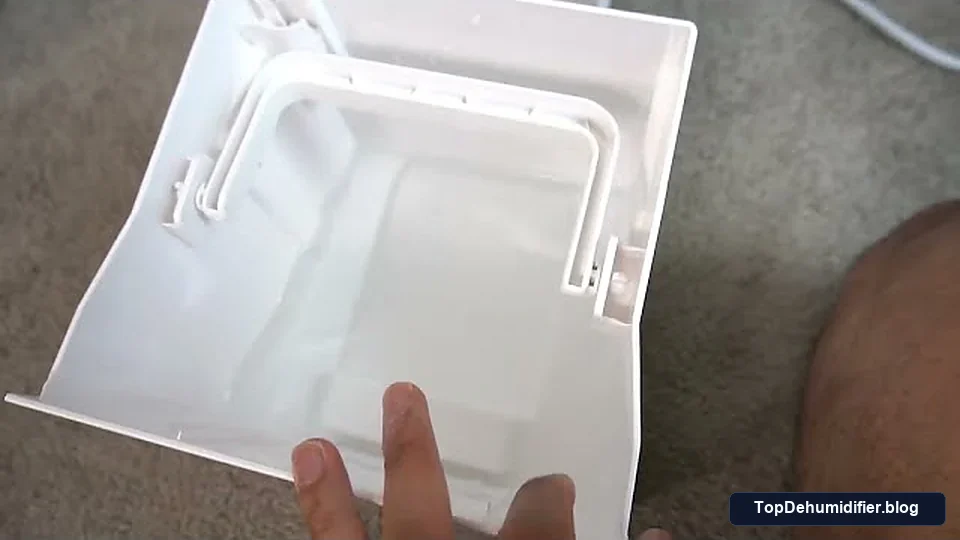
Bucket removal mechanisms must prevent accidental water spillage. Homelabs integrates an auto-shutoff float switch with a clear indicator. Tosot utilizes a hinged splash guard over the collection basin.
Gravity drainage requires reliable hose connections, and both units accept standard garden hoses. However, TOSOT includes a threaded brass drainage port that resists stripping far better than the molded plastic threads on HōmeLabs.
For vertical lift applications, internal condensate pumps must overcome significant head pressure. TOSOT offers robust pump integration options, whereas HōmeLabs relies more heavily on external auxiliary pumps for basement water removal tasks.
- Homelabs includes a continuous drain hose for gravity setups
- Tosot incorporates a secure splash guard on the water bucket
- Internal condensate pumps are available for vertical water lift
Drainage Reliability And Pumps
Gravity drainage works well when floor drains are nearby. Homelabs allows easy attachment of flexible vinyl tubing. Tosot features a rigid threaded outlet to prevent hose kinks.
Pump-equipped variants push water upward to distant windows. Homelabs offers external pump integration options. Tosot provides built-in internal pump models for seamless installation.
- Flexible tubing simplifies low-profile gravity drainage setups
- Internal pumps eliminate the need for manual bucket emptying
Long Term Durability And Maintenance Schedules
Routine upkeep ensures sustained efficiency over years of service. For smaller spaces, checking out the tosot 20 pint dehumidifier review highlights how the brand emphasizes durable condenser coatings that resist oxidation.
Component wear typically concentrates on moving blower parts. Homelabs uses sealed sleeve bearings requiring no lubrication. Tosot incorporates heavy-duty ball bearings for extended operational lifespans.
Regular filter cleaning preserves airflow dynamics. HōmeLabs utilizes a washable mesh filter that slides out easily, while TOSOT features a clipped polypropylene mesh screen designed to capture finer airborne particulate matter effectively.
Component longevity depends heavily on preventive coil maintenance. Technicians recommend annual coil washing using approved evaporator cleaners to maintain optimal heat transfer efficiency throughout the multi-year lifespan of these dehumidifiers.
- Homelabs filters slide out easily for routine water rinsing
- Tosot coatings protect coils in damp, corrosive spaces
- Sealed bearings eliminate the need for user lubrication
Filter Maintenance And Coil Care
Dust accumulation degrades thermal exchange efficiency rapidly. Homelabs features a washable nylon mesh filter screen. Tosot utilizes an antimicrobial mesh that traps fine airborne particulate matter.
Coil cleaning requires periodic inspection behind access panels. Homelabs allows straightforward vacuuming of exposed fins. Tosot benefits from annual professional coil washing to maintain output.
- Washable mesh screens reduce ongoing replacement expenses
- Antimicrobial treatments prevent mold growth on filter media
Frequently Asked Questions
Which brand offers better energy efficiency for continuous operation?
Homelabs typically leads in overall daily power efficiency. Their units maintain an Energy Star rating that minimizes electrical consumption during standard extraction cycles.
Can both models handle continuous gravity drainage without supervision?
Yes, both manufacturers include designated gravity drain ports for continuous setups. Users simply attach a standard garden hose to route water away safely.
Which dehumidifier operates more quietly in residential living areas?
Homelabs tends to produce lower decibel levels during normal operation. Their balanced fan design minimizes unwanted mechanical vibration in finished living spaces.
Are internal condensate pumps included standard on all units?
No, standard models rely strictly on gravity drainage or collection buckets. Specific variants from Tosot offer built-in internal pumps for vertical water lifting.
How often should the air filters be cleaned on these machines?
You should inspect and clean the mesh filters every two weeks. Regular maintenance preserves optimal airflow and prevents strain on the internal refrigeration compressor.