Ivation 13 Pint Desiccant vs Midea Cube
Choosing between desiccant technology and compressor engineering dictates your climate success. This technical guide contrasts structural mechanics and real-world utility.

Choose the Ivation desiccant for cold basements where thermal output matters, or select the Midea compressor for high-capacity whole-home humidity extraction.
Compare all top models in our Best Dehumidifier: Top Picks for Healthy Indoor Air.
Side-by-Side Breakdown
| Criteria | Ivation 13 Pint Desiccant | Midea Cube | Edge |
|---|---|---|---|
| Core Design / Build | Rotary desiccant wheel without compressor | Inverter compressor with nesting tank | Split Decision |
| Real-World Performance | Excels below 60°F ambient temperatures | Dominates standard warm, humid living spaces | Midea Cube |
| Ease of Setup & Use | Lightweight chassis with simple dials | Innovative expandable nesting design | Midea Cube |
| Durability & Reliability | Fewer moving parts, high heater longevity | Advanced electronics, sealed refrigeration loop | Ivation |
| Efficiency / Operating Footprint | Higher wattage due to internal heating element | Exceptional energy factor via inverter tech | Midea Cube |
| Maintenance Requirements | Simple periodic dust filter washing | Dual bucket cleaning and pump upkeep | Ivation |
| Best Ideal Use Case | Unheated crawlspaces and cold garages | Large basements and humid living areas | Split Decision |
Core Engineering Architecture
Mechanical design dictates how each unit interacts with ambient air. The Ivation relies on a thermal desiccant rotor that adsorbs moisture chemically without refrigeration components.
Conversely, the Midea utilizes a traditional vapor compression cycle paired with variable-speed inverter mechanics. This compressor backbone shifts operational capacity dynamically based on room humidity.
The Ivation unit utilizes a silica gel rotor wheel instead of a traditional compressor. This desiccant core absorbs water vapor directly into its microporous structure, enabling efficient operation in cold basements and unheated crawlspaces.
Conversely, our Midea Cube 20 Pint review details its standard compressor-based refrigeration cycle. By drawing moist air across cold evaporator coils, it condenses liquid water efficiently in warm, humid residential spaces.
- Desiccant wheels remove thermal dependency entirely.
- Compressor loops require active refrigerant circulation.
- Weight distributions reflect their internal mechanical cores.
Thermal Dynamics and Phase Change
Desiccant units pass humid air through a porous silica wheel. An internal heater regenerates the wheel, releasing warm dry air back into the conditioned space.
Compressor systems chill evaporator coils below the dew point. Condensate drips downward while exhaust air experiences minor warming across the condenser coils.
- Silica gel matrix traps water molecules.
- Refrigerant loops condense vapor via cooling.
Real-World Moisture Extraction
Extraction rates fluctuate dramatically depending on ambient room temperature and relative humidity levels. Testing reveals distinct operational boundaries for both engineering styles.
While compressor units lose efficiency sharply as temperatures drop, desiccant models maintain steady extraction even in near-freezing environments like uninsulated crawlspaces.
Desiccant systems like Ivation maintain a steady 13 pints daily removal rate regardless of ambient temperature drops. They do not suffer from frost buildup on coils, ensuring reliable performance in spaces below fifty degrees.
As detailed in our Midea Cube Smart Wifi review, this compressor unit extracts up to 50 pints daily. However, extraction efficiency plummets drastically when ambient temperatures fall below standard residential thresholds.
- Desiccant performance remains stable in cold air.
- Compressor units excel in warm, saturated spaces.
- Rated pint capacities use different baseline metrics.
Low-Temperature Behavior
Standard compressor coils freeze over when ambient temperatures dip below sixty degrees. The Ivation bypasses this limitation entirely through its heat-regenerated rotor design.
Users managing winter moisture in unheated cellars find desiccant technology superior. Compressor units simply cycle into defrost modes too frequently to maintain dryness.
- Coil icing halts standard compressor models.
- Thermal wheels operate continuously in the cold.
Usability, Ergonomics & Control Interfaces
User interfaces dictate daily operational friction and programming accuracy. As shown in our Midea Cube Smart Dehumidifier review, the unit features Wi-Fi integration and precise humidity adjustments.
Ivation keeps controls straightforward with tactile dials and basic LED indicators, prioritizing rapid manual adjustments over complex smartphone app connectivity.
Ivation features straightforward mechanical dials and basic digital readouts focused on fundamental humidity targets. Its lightweight chassis lacks heavy internal components, making portable room-to-room transfers remarkably simple for everyday users.
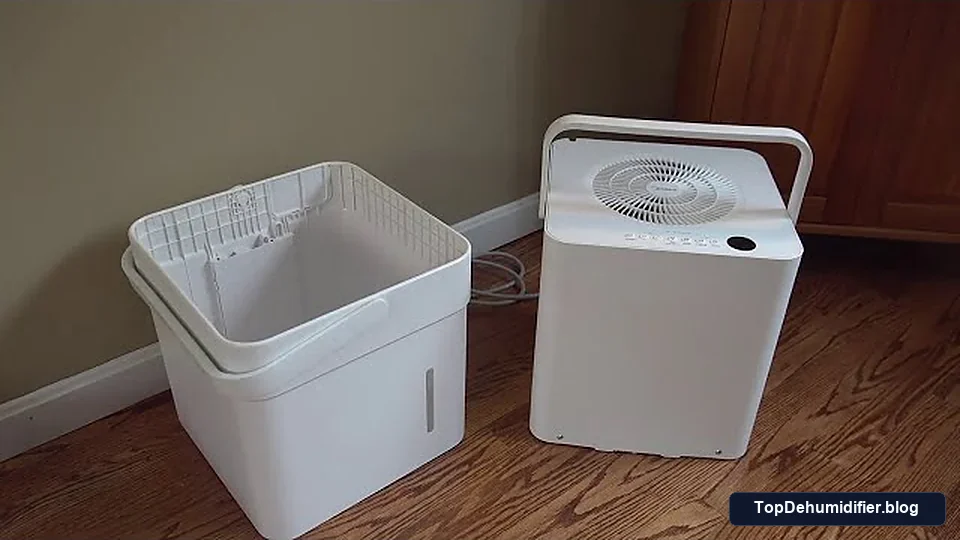
Midea integrates an advanced smart app interface alongside a nesting physical design. The water tank telescopes directly into the main unit body, reducing the overall footprint during off-season storage periods.
- Digital humidistats provide exact percentage readouts.
- Physical dials offer instant, fumble-free operation.
- App integration enables remote diagnostic monitoring.
Chassis Form Factor and Placement
The Midea features a unique nested design allowing the main body to sit directly inside its water tank. This space-saving footprint simplifies off-season storage significantly.
Ivation maintains a traditional vertical cabinet shape that requires standard floor space. Its lighter overall weight makes carrying the unit upstairs much easier.
- Nesting bucket design reduces vertical storage size.
- Lightweight frames improve portability between floors.
Drainage Mechanisms & Capacity Management
Managing extracted water effectively prevents overflow disasters and reduces manual intervention frequency. Both machines provide continuous gravity drainage alongside traditional bucket collection.
Midea incorporates a higher total water capacity and optional pump accessories, whereas Ivation relies on standard gravity hose routing through a rear port.
Continuous gravity drainage on the Ivation relies on a small rear port with an included hose. Users must position the unit on an elevated surface to ensure proper downward fluid flow.
Midea offers a massive extended-capacity tank system combined with open-bucket access. This allows users to lift the appliance directly off its basin for simplified cleaning and significantly less frequent manual emptying cycles.
- Gravity drainage bypasses manual bucket emptying.
- Internal lift pumps extend vertical drainage reach.
- Automatic shutoff triggers prevent floor flooding.
Continuous Drainage Reliability
Continuous drainage requires correct downward slope angles to prevent clogs. Midea fittings feel robust, minimizing accidental leaks during unattended long-term operation.
Ivation drainage ports sit lower on the chassis, requiring careful hose placement to ensure smooth, uninterrupted water flow into nearby floor drains.
- Hose angle determines gravity drainage success.
- Leak prevention seals protect finished flooring.
Energy Efficiency & Thermal Footprint
Power consumption patterns differ vastly between heating elements and compressor motors. Ivation draws steady electrical current to power its regeneration heater continuously.
Midea leverages variable-speed inverter technology to modulate wattage, delivering superior energy factor ratings during standard warm-weather extraction cycles.
Because desiccant technology requires an internal heating element to regenerate the rotor, the Ivation draws a higher continuous wattage relative to its modest moisture extraction volume in warm environments.
The Midea compressor model features a high Energy Star rating profile, cycling its compressor off once relative humidity targets are reached. This significantly reduces overall power consumption during standard residential operating seasons.
- Desiccant heaters consume constant high wattage.
- Inverter compressors scale power usage dynamically.
- Exhaust air temperature alters room climate.
Room Heating Side Effects
Operating a desiccant dehumidifier noticeably raises ambient room temperatures due to internal heating. This thermal output benefits cold spaces but burdens air-conditioned rooms.
Compressor units exhaust minimal heat, making them much more compatible with summer cooling loads in main living areas.
- Thermal wheels add gentle heat to rooms.
- Compressors maintain neutral climate impacts.
Maintenance Protocols & Longevity
Routine upkeep preserves mechanical efficiency and prevents mold growth inside internal reservoirs. Both systems demand regular air filter inspections to maintain airflow.
The Ivation features fewer complex moving parts, reducing long-term failure risks associated with sealed refrigerant loops and electronic inverter boards.
Routine maintenance for the Ivation involves washing its removable dust filter and inspecting the desiccant wheel for particulate accumulation. Keeping airflow unobstructed prevents premature heater burnout and ensures extended operational lifespan.
Midea requires regular coil sanitization and comprehensive basin cleaning routines to prevent mold growth inside the enclosed cube reservoir. Checking the drainage channels periodically prevents accidental overflows and mechanical pump failures.
- Washable dust filters capture airborne particulates.
- Bucket sanitation stops bacterial slime buildup.
- Coil cleaning maintains optimal heat transfer.
Component Lifespan Expectations
Compressor systems typically last many years when refrigerant charges remain intact. However, electronic control boards remain vulnerable to power surges and humidity exposure.
Desiccant wheels degrade slowly over extended operational hours, but the absence of compressors often translates to greater mechanical durability in harsh environments.
- Sealed refrigerant systems require professional service.
- Desiccant rotors resist mechanical wear effectively.
Final Environmental Fit Analysis
Selecting the optimal dehumidifier depends entirely on your specific spatial climate challenges. Evaluate temperature baselines before committing to a heating or cooling architecture.
Match the Midea compressor to large, warm living areas, while reserving the Ivation desiccant for cold, challenging spaces needing dependable winter extraction.
Choose the Ivation desiccant system if your primary deployment zone involves unconditioned, cold areas like RVs, garages, or winter cabins where standard compressor units completely fail to extract ambient moisture.
When managing humidity in climate-controlled living spaces, our Midea Cube 50 Pint review highlights high-volume extraction, quiet acoustics, and convenient smartphone monitoring capabilities throughout damp seasonal weather patterns.
- Analyze typical room temperatures before buying.
- Consider seasonal humidity swings across your region.
- Factor storage and drainage constraints into choices.
Making Your Final Decision
Homeowners facing damp, freezing cellars will achieve superior results with the Ivation desiccant model. Its thermal wheel conquers cold air limitations effortlessly.
Conversely, standard basements and main floors benefit immensely from the Midea Cube due to its massive capacity and energy-saving inverter compressor.
- Cold spaces demand desiccant heating technology.
- Warm areas require efficient compressor extraction.
Frequently Asked Questions
Which unit works better in cold unheated basements?
The Ivation desiccant model excels in cold spaces because it avoids coil freezing issues entirely. Its thermal wheel maintains consistent extraction rates regardless of low ambient temperatures.
Does the Midea Cube increase summer electric bills significantly?
The Midea Cube uses an advanced inverter compressor that scales power dynamically. This variable-speed operation delivers high energy efficiency during standard warm-weather humidity cycles.
How does the Ivation unit affect room temperature?
Because it relies on an internal heating element to regenerate the desiccant rotor, the Ivation exhausts warm air. This gentle heating effect is ideal for cold spaces but can slightly warm air-conditioned rooms.
Can both dehumidifiers run continuously with a drain hose?
Both models support continuous gravity drainage to bypass manual bucket emptying. Proper hose angling is crucial to ensure uninterrupted water flow into your chosen drainage point.
Which dehumidifier is easier to store during the off-season?
The Midea Cube features an innovative nesting design where the main body stores inside its water bucket. This creates a compact storage footprint compared to standard vertical units.