Overhead vs Floor Mount Crawl Space Dehumidifiers
Selecting the right crawl space moisture management setup requires balancing ceiling clearance against floor stability. Our technical guide breaks down exact engineering trades.

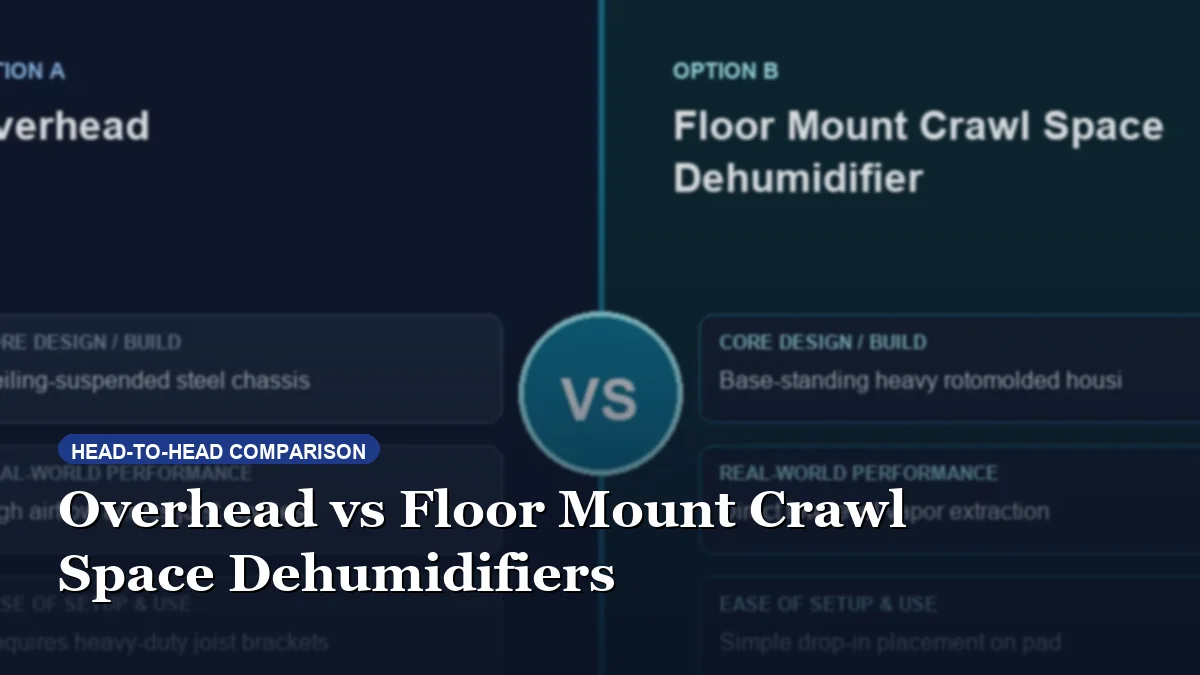
Choose overhead suspension if your subfloor clearance is tight and you want to protect equipment from standing water. Opt for floor mounting when structural joists cannot safely support suspended mechanical loads.
Compare all top models in our Best Dehumidifier: Top Picks for Healthy Indoor Air.
Side-by-Side Breakdown
| Criteria | Overhead | Floor Mount Crawl Space Dehumidifier | Edge |
|---|---|---|---|
| Core Design / Build | Ceiling-suspended steel chassis | Base-standing heavy rotomolded housing | Overhead |
| Real-World Performance | High airflow across joist cavities | Direct low-level vapor extraction | Floor Mount |
| Ease of Setup & Use | Requires heavy-duty joist brackets | Simple drop-in placement on pad | Floor Mount |
| Durability & Reliability | Isolated from localized ground flooding | Vulnerable to high-water incidents | Overhead |
| Efficiency / Operating Footprint | Utilizes dead overhead crawl space | Consumes valuable floor perimeter space | Overhead |
| Maintenance Requirements | Awkward filter access overhead | Ergonomic ground-level filter sliding | Floor Mount |
| Best Ideal Use Case | Low-clearance, damp-prone subfloors | Dry, level crawl space pads | Overhead |
Installation Engineering and Structural Mounting
When browsing the best dehumidifier for crawl space under house selections, robust mounting strategies are essential. Suspended overhead systems require rigid connection points using threaded steel rods and brackets.
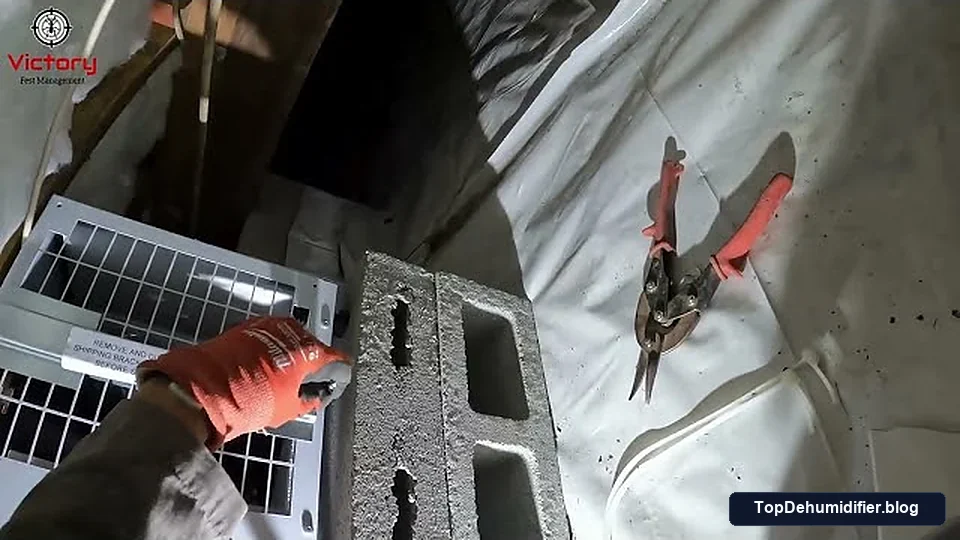
Conversely, floor-mounted appliances rely on a stable concrete pad or vapor barrier base. Engineers must calculate total dead load limitations before anchoring any heavy apparatus to overhead wooden floor joists safely.
Overhead suspension requires heavy-duty threaded rods anchored directly into floor joists to support dynamic unit weight safely. Engineers must calculate total load limits before drilling into older dimensional lumber to prevent structural sagging or localized timber failure.
Floor placement demands a stable surface constructed from poured concrete or crushed stone topped with a vapor barrier. Using anti-vibration pads underneath the chassis prevents direct ground contact, reducing moisture absorption and long-term metal hull corrosion.
- Overhead systems demand rated joist clamps and heavy-duty load-bearing hardware.
- Floor units require level, compacted gravel or poured concrete pads for stability.
- Weight distribution prevents long-term sagging of residential subfloor framing timber.
Joist Integrity and Load Limits
Hanging a heavy dehumidifier places continuous stress on wooden floor joists. Structural engineers recommend reinforcing compromised timbers with sister boards before mounting any heavy overhead mechanical equipment.
Floor models eliminate joist stress entirely by transferring unit weight directly to the earth. This approach protects your home framing from long-term fatigue and structural settling issues over time.
- Joist reinforcement prevents structural deflection and sagging floors.
- Floor setups bypass framing load limits completely.
Condensate Drainage Dynamics and Pumping
Managing extracted water efficiently is critical for preventing secondary moisture damage in enclosed crawl spaces. Overhead systems almost always require an internal condensate pump to lift water upward to exterior discharge lines.
Floor-mounted units can frequently utilize gravity drainage if positioned correctly relative to foundation exit points. However, low-profile floor units may still require auxiliary pumps during heavy extraction cycles in damp seasons.
Overhead units rely entirely on integrated condensate pumps to lift moisture vertically against gravity through flexible tubing. Technicians must secure discharge lines with proper clamping to prevent high-pressure disconnects and subsequent ceiling-level water damage inside confined crawl spaces.
Floor-mounted systems can utilize gravity drainage routes if installed on a slight downward slope toward exterior sump pits. When gravity flow is unavailable, low-profile external condensate removal pumps clear accumulated water horizontally without requiring steep vertical head pressure.
- Overhead units mandate reliable internal condensate pumps with check valves.
- Floor units can leverage gravity drainage if slope parameters are met.
- Pump failure risks standing water accumulation beneath the dehumidifier housing.
Gravity versus Pump Reliability
Gravity drainage offers ultimate reliability because it features zero mechanical failure points. When installing floor units, maintaining a proper downward slope ensures continuous water evacuation without electrical intervention.
Overhead installations depend entirely on pump motor longevity. Selecting a model with an accessible reservoir float switch prevents accidental overflow events inside your dark subfloor.
- Gravity lines eliminate electrical pump failure risks.
- Pump reservoirs require periodic cleaning to prevent biological growth.
Airflow Distribution and Moisture Extraction Efficiency
When selecting the best dehumidifier for crawl space, matching unit capacity to square footage is vital. Proper airflow prevents moisture pockets near wooden sill plates and rim joists.
Floor-mounted appliances draw damp air from ground level where humidity pools due to vapor drive. Positioning intake grills correctly ensures the appliance processes heavy stagnant air before mold colonies establish.
Suspended dehumidifiers capture warm, rising air near subfloor framing, ensuring rapid thermal stratification disruption throughout the upper crawl space cavity. This elevated positioning accelerates moisture extraction by drawing from the warmest ambient air zone available.
Floor setups ingest cooler air above the soil, necessitating external ductwork layouts to force treated air into stagnant corners. Proper supply and return duct separation prevents short-cycling and maintains balanced relative humidity across the footprint.
- Overhead airflow targets high wooden framing components directly.
- Floor airflow captures heavy moisture pooling near earth vapor barriers.
- Proper ducting integration enhances overall moisture extraction rates.
Ducting and Air Scrubbing Performance
Complex crawl space layouts often require auxiliary ducting to eliminate dead air pockets. Overhead systems can easily accept intake and output flex ducts to push conditioned air into isolated crawl space bays.
Floor units typically rely on un-ducted open-room circulation patterns. While simpler to operate, this approach can leave remote corners vulnerable to localized high relative humidity pockets.
- Ducting kits allow targeted drying in segmented foundation layouts.
- Open-room circulation requires unobstructed pathways for optimal efficiency.
Structural Load Capacity and Vibration Damping
Mechanical compressors generate constant low-frequency vibrations that can echo through home framing. Overhead suspensions require specialized rubber isolation mounts to decouple the appliance chassis from wooden floor joists.
Choosing the best rated crawl space dehumidifier ensures mechanical resonance transfers directly into the concrete slab. This natural dampening prevents annoying hums from reaching living area floorboards above.
Suspending heavy equipment introduces continuous dynamic loads onto wooden joists, requiring engineered load-sharing brackets to distribute weight evenly. Without proper reinforcement, continuous compressor vibrations can loosen structural fasteners and degrade surrounding framing timber over time.
Floor installations eliminate overhead framing strain, transferring dead weight directly to the earth via high-density pads. These specialized isolators absorb high-frequency compressor hum, stopping acoustic resonance from traveling upward into the living space above.
- Vibration isolators prevent annoying mechanical hums in living spaces.
- Soil absorption naturally dampens floor unit operating frequencies.
- Improperly secured overhead frames amplify compressor noise significantly.
Acoustic Mitigation in Residential Zones
Homeowners frequently complain about mechanical noise transmitted through subfloor assemblies. Installing high-density rubber pads under floor mounts or hanging brackets successfully absorbs objectionable acoustic energy.
Maintaining proper clearance around the chassis prevents cabinet rattling against surrounding foundation walls, ensuring quiet and efficient long-term continuous operation.
- Rubber decoupling pads eliminate subfloor acoustic transmission.
- Clearance checks prevent annoying panel vibration noises.
Maintenance Accessibility and Filter Servicing
Routine filter cleaning is essential for preserving evaporator coil efficiency and airflow rates. Floor-mounted units offer superior ergonomic access, allowing technicians to slide out filters easily without awkward overhead stretching.
Overhead maintenance requires crawling into tight spaces and reaching upward to access filter doors. This added physical strain can lead to neglected maintenance schedules and reduced appliance lifespan.
Reviewing options from our best crawl space dehumidifier consumer reports guide highlights how overhead configurations restrict routine servicing. Technicians face awkward postures performing basic filter replacements in confined spaces.
Floor-mounted units provide superior ergonomic access, allowing quick slide-out tray removal and straightforward washable MERV filters maintenance. Technicians can easily access internal terminal blocks and refrigeration service ports without navigating tight overhead suspension hardware.
- Floor units provide easy, ergonomic filter access for homeowners.
- Overhead filters demand awkward reaching in confined subfloor spaces.
- Neglected filters restrict airflow and damage internal compressor coils.
Ergonomics and Long-Term Servicing
Simplified maintenance routines directly correlate with better appliance longevity and performance. Choosing floor models ensures you will inspect intake screens regularly without physical contortions under low clearance beams.
If you must choose an overhead configuration, verify that the filter door swings open downward rather than pulling outward into restricted clearance zones.
- Accessible filters encourage frequent user inspection habits.
- Downward-opening doors simplify tight overhead service tasks.
Electrical Safety and Wet-Location Compliance
Crawl spaces present challenging electrical environments due to high ambient moisture and potential flooding. Overhead mounting elevates sensitive electronic control boards well above historical high-water mark thresholds.
Floor-mounted appliances sit dangerously close to dirt floors and potential plumbing leaks. Every installation must utilize a dedicated GFCI-protected circuit to ensure absolute electrical safety compliance.
Crawl spaces require strict adherence to GFCI protection codes due to high ambient humidity and standing groundwater risks. Overhead mounting keeps primary control boards safely elevated above potential flood levels, minimizing catastrophic short-circuit hazards.
Floor placement demands elevated electrical receptacles and weatherproof enclosures to withstand seasonal moisture spikes or plumbing leaks. Technicians must verify that all cord connections remain completely dry and elevated above the vapor barrier surface.
- Overhead units keep electronics safe from minor ground flooding.
- Floor units require strict GFCI protection and elevated pads.
- Water ingress risks catastrophic short circuits and compressor burnout.
Circuit Protection and Code Requirements
National electrical codes mandate strict safety protocols for damp subterranean spaces. Ensure your contractor installs weather-resistant receptacle boxes and appropriate breaker protection for continuous heavy loads.
Elevating floor units on concrete blocks adds an extra layer of defense against unexpected plumbing leaks or heavy seasonal groundwater accumulation events inside your enclosed foundation perimeter.
- Weather-resistant receptacles protect against corrosive subfloor humidity.
- Concrete blocks elevate floor units above minor puddling risks.
Long-Term Reliability and Cost of Operation
Maximizing your return on investment depends on overall equipment durability and energy efficiency. Overhead units protect mechanical housings from ground dampness, preserving external chassis integrity over decades.
Floor units simplify initial setup and routine repairs, reducing overall contractor labor expenses. Balancing energy draw against local utility rates ensures optimal long-term operational economy for your home.
Suspension systems eliminate direct contact with corrosive soil gases, protecting the outer casing and extending component lifespans significantly. However, repairing internal refrigerant leaks in hanging units incurs higher labor costs due to awkward working positions.
Floor units offer lower initial installation labor but face higher exposure to rising dampness, which can accelerate chassis corrosion over decades. Selecting coated coils and heavy-duty composite bases ensures balanced long-term operational reliability regardless of mounting style.
- Overhead chassis resist ground moisture corrosion effectively.
- Floor units simplify technician diagnostics and part replacements.
- Energy Star ratings help minimize monthly electricity expenditure.
Total Cost of Ownership Analysis
Evaluating upfront installation costs alongside ongoing maintenance expenses provides a complete financial picture. Overhead systems often incur higher initial labor fees due to complex structural rigging.
Floor models minimize installation complexity but may require replacement sooner if unexpected subfloor flooding compromises lower electrical components inside the protective housing.
- Rigging overhead units increases professional installation expenses.
- Floor models face higher flood vulnerability risks.
Frequently Asked Questions
Can I install an overhead dehumidifier myself without professional framing help?
Hanging heavy mechanical equipment requires specialized structural knowledge to prevent joist damage. Always consult a licensed contractor before mounting heavy units to overhead framing.
Are floor-mounted dehumidifiers safer against unexpected crawl space flooding events?
Floor units sit directly near the vapor barrier and face higher risks during severe water intrusion. Elevating floor models on concrete blocks helps mitigate unexpected puddling hazards.
Do overhead dehumidifiers vibrate and create noise inside the living room?
Suspended units can transmit low-frequency hums if rubber isolation brackets are omitted during installation. Using proper vibration damping hardware ensures quiet operation throughout your home.
Which configuration offers better air circulation in very tight crawl spaces?
Overhead systems excel at blanketing upper subfloor cavities and rim joists with dry air. This makes them ideal for low-clearance foundations requiring targeted structural drying.
How often should I clean the air filters on a crawl space dehumidifier?
Inspect and clean your appliance filters every two to three months to maintain optimal airflow. Regular maintenance prevents premature compressor failure and reduces overall energy consumption.