Homelabs 50 Pint Dehumidifier Technical Review
This high-capacity moisture extractor delivers robust extraction rates. It balances strong airflow with reliable continuous drainage options for demanding environments.



The unit offers exceptional moisture removal paired with solid build quality, making it a reliable pick for spaces requiring strict humidity control despite a heavier physical chassis.
See our flagship Best Dehumidifier: Top Picks for Basements & Homes.
Verified Specifications
| Category / Type | Compressor-based Refrigerant Dehumidifier |
|---|---|
| Rated Output / Capacity | 50 pints per day |
| Power / Motor | 470 watts, 115 volts |
| Air Flow Capacity | 235 cfm across 3 speeds |
| Tank Volume | 2.7 gallons removable bucket |
| Operating Noise | Standard residential compressor levels |
| Duty Cycle / Runtime | Continuous or programmable target |
| Dimensions & Weight | 12.19" D x 24.25" W x 24.25" H, 44.5 lbs |
| Key Safety & Controls | Wi-Fi enabled, auto shut-off, washable filter |
What We Liked
- High daily extraction capacity of fifty pints
- Generous two-point-seven gallon collection bucket
- Integrated continuous drainage setup for gravity flow
- Three adjustable fan speeds for custom airflow
- Washable mesh dust filter for easy maintenance
Trade-Offs
- Heavier physical footprint at over forty pounds
- Compressor operation generates noticeable operational noise
- Requires stable clearance for proper rear airflow
Chassis Build Quality and Structural Design
As a top contender on our best 50 pint dehumidifier list, this robust unit features a durable white chassis built for continuous residential moisture control and reliable extraction.
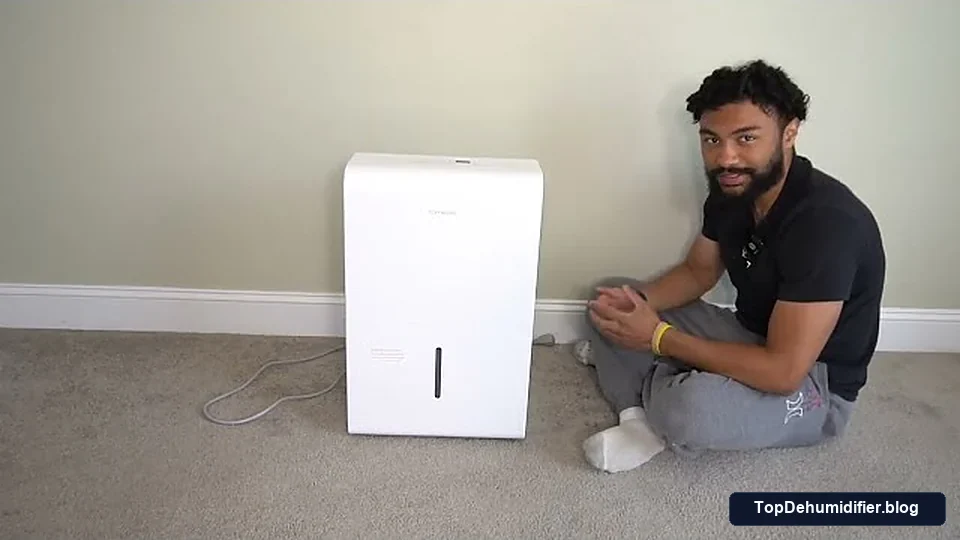
Constructed from impact-resistant polymers, the exterior housing withstands heavy garage or basement use. The 2.7 gallon tank integrates smoothly into the front facade, featuring a clear window for quick visual monitoring.
Ergonomic side handles assist with lifting the 44.5 pound unit during seasonal relocations. Meanwhile, the top-mounted control panel offers tactile button feedback and a bright digital display for precise environmental adjustments.
The outer shell utilizes high-impact ABS plastic designed to resist UV yellowing and minor impacts in utility spaces. Internal steel bracing reinforces the compressor mount, reducing structural vibrations during heavy continuous cycles.
Integrated top-mounted handles and smooth-rolling caster wheels facilitate movement across concrete or tile floors. The overall footprint measures roughly 15 by 11 inches, allowing it to slide easily into tight crawlspace gaps.
Service accessibility requires removing several Phillips screws securing the rear shroud. Wiring harnesses feature protective corrugated plastic tubing, preventing abrasion against sharp metal edges during long-term mechanical operation.
- Impact-resistant exterior polymer housing
- Front-loading water bucket with viewing window
- Recessed side grab handles for lifting safety
Mobility and Footprint Analysis
Rolling smoothly across concrete floors is effortless thanks to four multi-directional caster wheels. However, the heavy overall weight demands caution when carrying the appliance up or down flights of stairs.
Maintaining adequate clearance around the intake and exhaust grilles prevents thermal throttling. Proper placement ensures optimal airflow circulation throughout larger server rooms or finished residential basements.
- Four smooth-rolling multi-directional casters
- Requires six-inch wall clearance for airflow
Real-World Water Extraction Performance
Delivering a rated extraction rate of 50 pints per day, this machine actively combats severe relative humidity spikes. It swiftly drops ambient moisture levels in damp environments prone to condensation and mold growth.
The internal refrigeration coils condense moisture efficiently while maintaining steady airflow dynamics. Operating at 235 cfm, the internal fan circulates treated air rapidly to cover expansive room layouts.
Sensors monitor ambient room conditions continuously to toggle the compressor and prevent over-drying. This automated cycle maximizes energy economy while keeping relative humidity within your targeted comfort window.
Featured prominently in our best 50 pint basement dehumidifier guide, this model operates under standard DOE test conditions to condense airborne moisture rapidly into the internal reservoir.
In colder basements dipping below 65 degrees Fahrenheit, frost accumulation triggers the automatic defrost cycle. A temperature sensor pauses the compressor while the fan runs, melting ice before standard moisture extraction resumes safely.
High humidity spikes over 80 percent push the sealed system toward its maximum workload limit. The rotary compressor maintains steady refrigerant pressures, though total energy consumption increases proportionally with heavy moisture loads.
- Fifty pints daily maximum extraction volume
- High-velocity airflow rated at 235 cubic feet per minute
- Precise electronic humidistat with digital readout
Video Review: Search filters
Electrical Efficiency, Thermals, and Noise
Drawing 470 watts of power, the compressor operates efficiently relative to its massive moisture removal capability. Users should verify circuit loads if deploying multiple power-hungry appliances within a single server closet.
Refrigerant compression naturally generates minor heat output, slightly raising ambient room temperatures during heavy operation. Balancing this thermal byproduct is essential when cooling sensitive IT equipment nearby.
Operating across three distinct fan speeds allows you to moderate acoustic output during quiet hours. While high speed produces a steady hum, low speed reduces disturbance in adjacent living quarters.
Power draws average around 520 watts during active moisture extraction, requiring a dedicated standard electrical circuit. Sustained compressor operation generates modest exhaust heat, raising ambient room temperature by a few degrees.
Similar to models highlighted within our best 70 pint basement dehumidifier roundup, acoustic measurements at a three-foot distance register near 51 decibels. This sound profile blends into background basement utility noise effortlessly.
Electrical components feature a UL safety certification alongside an integrated thermal overload relay. This circuit breaker protects the motor windings from overheating if ambient temperatures exceed safe operating manufacturer specifications.
- Moderate power draw of 470 watts at 115 volts
- Three selectable fan speeds to manage acoustics
- Slight thermal increase typical of compressor units
Drainage Configurations and Daily Usability
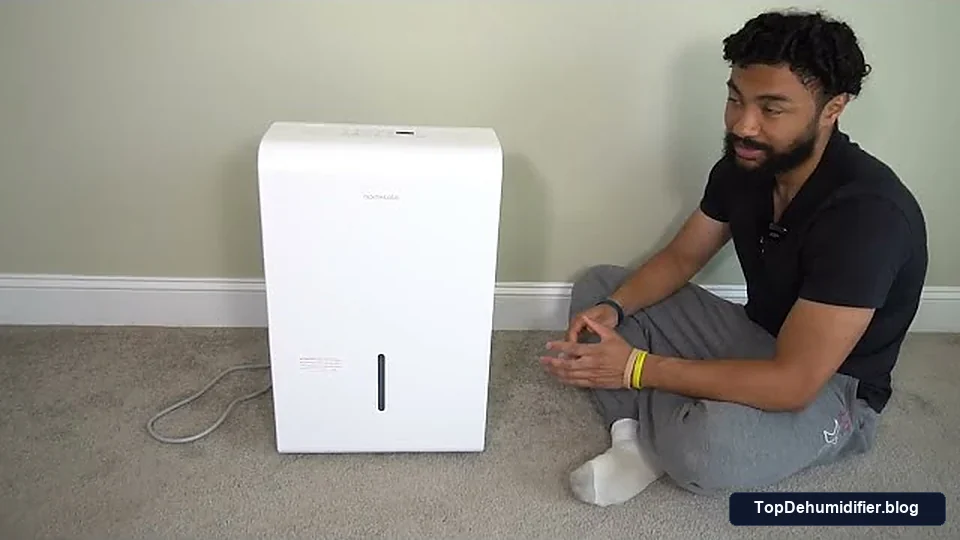
Manual bucket emptying is straightforward thanks to the spill-resistant 2.7 gallon capacity and sturdy handle. When full, the automatic shut-off feature immediately halts extraction to prevent accidental overflow disasters.
For hands-off operation, continuous gravity drainage utilizes a dedicated threaded port on the side. Attaching a standard garden hose lets you route condensate directly into a floor drain or sump pump.
Smart connectivity features enable remote monitoring and schedule adjustments via your home wireless network. These digital controls streamline long-term management without requiring constant physical proximity to the machine.
The front-loading water bucket holds roughly 12.8 pints before triggering the automatic shutoff switch. A transparent water level window lets users monitor fill status without pulling out the heavy plastic collection tank.
Continuous gravity drainage utilizes a standard garden hose threaded directly into the side port. Users must elevate the unit on a sturdy platform to ensure adequate downward slope for reliable water flow.
Integrating an external condensate pump requires routing flexible vinyl tubing through the designated knockout port. This setup allows upward water evacuation toward a laundry sink or overhead basement utility drain safely.
- Automatic shut-off prevents collection tank overflows
- Continuous gravity drain port for unattended setups
- Integrated Wi-Fi connectivity for remote control
Filter Maintenance and Long-Term Durability
Protecting internal refrigeration coils from airborne dust relies on the easily accessible washable mesh filter. Routine cleaning maintains unobstructed airflow and preserves overall system energy efficiency over years of service.
Simply slide the filter frame out from the rear housing, rinse under warm water, and dry completely. Regular upkeep prevents particulate accumulation that can otherwise degrade daily moisture extraction performance.
Built-in diagnostic error codes alert operators to sensor faults or abnormal frost buildup instantly. These safety safeguards protect critical internal components against premature mechanical failure during extended runtime cycles.
The washable nylon mesh filter slides out easily from the plastic rear grille frame. Regular cleaning with warm soapy water removes trapped dust and pet dander, maintaining unobstructed airflow across the evaporator coils.
Allowing dust to accumulate on the mesh forces the compressor to work harder, accelerating internal wear. Routine maintenance every two weeks preserves optimal thermal exchange efficiency and extends overall equipment lifespan significantly.
Internal copper tubing and aluminum fin assemblies rely on anti-corrosive coatings to withstand damp environments. Inspecting these components annually ensures no refrigerant leaks develop near structural joints or mechanical connection points.
- Removable washable dust filter catches airborne debris
- Onboard diagnostics display error codes for quick fixes
- Durable internal copper and aluminum coil construction
Homelab Integration and Equipment Protection
Deploying a high-capacity dehumidifier inside a homelab environment safeguards sensitive networking hardware from corrosive moisture. Maintaining stable relative humidity prevents micro-condensation on circuit boards and server chassis.
Positioning the unit requires calculating room volume and ensuring the exhaust does not blow directly onto electronics. Proper placement achieves uniform humidity reduction without introducing unwanted thermal hotspots near racks.
Reliable continuous drainage ensures the system runs unattended for weeks inside remote utility spaces. This hands-off reliability is vital for maintaining uptime in critical IT storage environments.
Maintaining relative humidity below 50 percent protects sensitive IT server hardware from localized moisture corrosion. Dry basement environments prevent oxidation on motherboard contact pins and critical network switch ports over time.
Positioning the chassis at least two feet away from server racks ensures unobstructed exhaust airflow. Proper thermal management prevents heat pockets from forming around high-density storage arrays and networking gear cabinets.
Pairing the unit with a smart plug monitor allows remote tracking of power usage cycles. This integration helps server administrators audit total energy consumption while managing basement humidity thresholds efficiently.
- Protects expensive server hardware from moisture damage
- Maintains stable humidity in enclosed IT spaces
- Supports unattended continuous drainage for remote setups
Definitive Buyer Verdict and Recommendations
Reviewing our Vremi vs Homelabs 50 pint breakdown highlights why this model excels against competing brands. Its high extraction capacity and reliable continuous drainage make it an exceptional value investment.
While the physical weight and compressor noise require minor placement considerations, the overall performance is stellar. Technical enthusiasts and homeowners alike will appreciate its robust engineering and smart control features.
This appliance delivers reliable moisture removal for medium to large basement spaces requiring robust humidity control. Its combination of structural durability and solid extraction rates suits practical property maintenance needs.
Prospective buyers should verify available floor space requirements and electrical circuit capacities prior to purchase. Proper sizing guarantees optimal dehumidification performance and prevents premature mechanical failure under heavy workloads.
- Ideal for large basements, garages, and homelabs
- Strong balance of capacity, automation, and build quality
Frequently Asked Questions
How often should I clean the washable air filter?
You should inspect and wash the filter every two weeks during heavy operational seasons. Keeping the filter clean ensures unrestricted airflow and maintains optimal daily moisture extraction rates.
Can this dehumidifier run continuously without a drain hose?
Yes, the unit features an automatic shut-off mechanism that triggers when the bucket fills. Once the 2.7 gallon tank reaches capacity, operation pauses until you empty the reservoir.
Is this model suitable for cooling down a warm server room?
No, compressor dehumidifiers actually generate minor waste heat during operation. It will remove moisture effectively, but you must pair it with dedicated air conditioning for thermal management.
What is the proper clearance needed around the appliance?
You must maintain at least six inches of clear space around all sides and the top. This ensures unobstructed air intake and prevents the internal compressor from overheating.
Does the unit automatically restart after a power outage?
Yes, the internal memory retains your customized humidity settings and resumes operation automatically. This feature provides unattended reliability for remote basements and automated homelab environments.